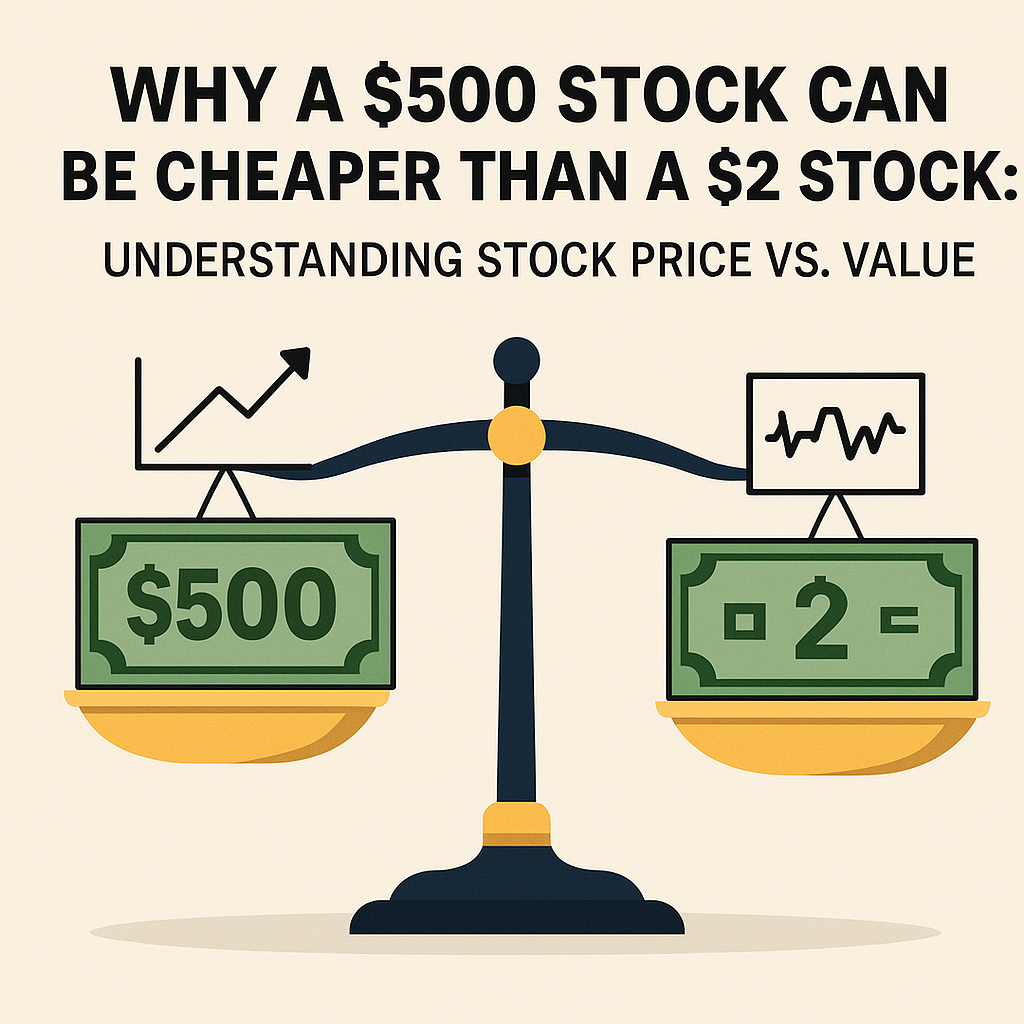
A $500 Stock Can Be Cheaper Than a $2 Stock: Understanding Stock Price vs. Value
When you’re starting your investment journey, it’s natural to think that a stock trading at $500 is more expensive than one trading at $2. After all, you’d need $500 to buy one share of the pricey stock versus just $2 for the cheaper one. But here’s the counterintuitive truth that every successful investor must understand: the ticker price of a stock tells you absolutely nothing about whether that stock is expensive or cheap.
Think of it this way: would you rather buy a luxury car for $50,000 or a broken-down vehicle for $60,000? The cheaper price tag doesn’t make the second option a better deal. The same principle applies to stocks, and understanding this difference can be the key to making profitable investment decisions.
The Fundamental Difference: Price vs. Value
Stock price is simply what you pay for one share at any given moment. It’s determined by supply and demand in the market and can fluctuate wildly based on investor emotions, news headlines, and market sentiment.
Stock value, on the other hand, represents the true worth of a company based on its fundamentals: earnings, assets, growth prospects, competitive position, and future cash flow potential. Value is what you actually get for your money.
The magic happens when you find stocks where the price is significantly lower than the value—that’s where the money is made.
Why Stock Price Alone Is Meaningless
Let’s use a simple analogy. Imagine two pizzas:
- Pizza A costs $20 and has 8 slices
- Pizza B costs $10 and has 2 slices
Which pizza gives you more value per slice? Pizza A gives you 8 slices for $20 ($2.50 per slice), while Pizza B gives you 2 slices for $10 ($5 per slice). Even though Pizza A has the higher total price, it’s actually the cheaper option per slice.
The same logic applies to stocks. What matters isn’t the absolute price per share, but what you get for that price in terms of the company’s earnings, assets, and growth potential.
The Power of the Price-to-Earnings (P/E) Ratio
The most important tool for understanding stock value is the Price-to-Earnings (P/E) ratio. This metric tells you how much you’re paying for each dollar of the company’s annual earnings.
P/E Ratio = Stock Price ÷ Earnings Per Share
A lower P/E ratio generally indicates better value, regardless of the actual stock price. Here’s why this matters:
- A stock trading at $100 with earnings of $10 per share has a P/E ratio of 10
- A stock trading at $5 with earnings of $0.10 per share has a P/E ratio of 50
The $100 stock is actually much cheaper because you’re paying 10 times earnings versus 50 times earnings for the $5 stock.
Real-World Examples That Will Surprise You
Example 1: Berkshire Hathaway vs. Penny Stocks
Berkshire Hathaway Class A (BRK.A) trades at around $750,000 per share—making it the most expensive stock by price on U.S. exchanges. At first glance, this seems impossibly expensive for amateur investors.
However, when we look at the fundamentals:
- The company generates enormous profits relative to its share count
- It has a P/E ratio of approximately 11, which is quite reasonable
- The intrinsic value is estimated around $563,614 per share, suggesting it might actually be undervalued
Compare this to many penny stocks trading under $5 that have:
The $750,000 stock is actually a better value than many $2 stocks.
Example 2: Google vs. Amazon – A Tale of Two Tech Giants
Let’s examine two tech giants with different stock prices but dramatically different valuations:
Alphabet (Google) – GOOG:
- Stock price: Around $193
- P/E ratio: Approximately 20-22
- Profit margins: Over 30%
- Growing at about 14% annually
Amazon – AMZN:
- Stock price: Around $215
- P/E ratio: Approximately 37-42
- Profit margins: Around 11%
- Growing at about 11% annually
Despite Amazon’s stock price being only slightly higher than Google’s, Amazon is significantly more expensive from a valuation standpoint. You’re paying nearly twice as much for each dollar of earnings with Amazon compared to Google.
Example 3: Tesla vs. Ford – The EV Revolution Paradox
This comparison perfectly illustrates how stock price can mislead investors:
Tesla (TSLA):
- Stock price: Around $350
- P/E ratio: Approximately 175-186
- Currently considered overvalued by many analysts
Ford (F):
Tesla’s stock price is about 30 times higher than Ford’s, but Tesla is actually the more expensive stock. You’re paying 175 times earnings for Tesla versus less than 15 times earnings for Ford. This means Ford gives you much more earning power per dollar invested, despite its much lower stock price.
Why Do These Price Discrepancies Exist?
Several factors create these seemingly irrational price differences:
Market Sentiment and Emotions
Investors often pay premiums for “exciting” growth stories or companies in trendy sectors, regardless of current profitability. Tesla commands a high valuation partly due to excitement around electric vehicles and autonomous driving, even though current earnings don’t justify the price.
Growth Expectations
High-priced stocks often reflect expectations of massive future growth. Investors are willing to pay more today for companies they believe will dominate tomorrow. However, these growth expectations don’t always materialize.
Share Count Differences
Companies can have vastly different numbers of shares outstanding. A company worth $10 billion could have:
- 1 million shares at $10,000 each
- 1 billion shares at $10 each
The total value is identical, but the per-share prices are dramatically different.
Stock Splits and Corporate Actions
Companies like Berkshire Hathaway have never split their stock, keeping the per-share price high. Others split regularly, keeping share prices “affordable” even as the company grows.
How to Identify Real Value: Your Investment Toolkit
1. Focus on Valuation Metrics, Not Price
- P/E Ratio: How much you pay for each dollar of earnings
- Price-to-Book (P/B): Stock price versus book value per share
- Price-to-Sales: How much you pay for each dollar of revenue
- PEG Ratio: P/E ratio adjusted for growth rate
2. Compare Within Industries
A P/E ratio of 15 might be expensive for a utility stock but cheap for a technology stock. Always compare companies within similar industries.
3. Look at the Business Fundamentals
- Profit Margins: How much profit the company keeps from each dollar of sales
- Revenue Growth: Is the business expanding?
- Debt Levels: Is the company financially stable?
- Competitive Position: Does it have sustainable advantages?
4. Consider the Company’s Future Prospects
Value investing isn’t just about current metrics—it’s about buying companies whose futures are brighter than their current stock price suggests.
Common Mistakes Amateur Investors Make
The “Cheap Stock” Trap
Many beginners gravitate toward low-priced stocks, thinking they’re getting a bargain. This often leads to investments in struggling companies with poor fundamentals.
Ignoring Market Capitalization
A $5 stock of a company with 10 billion shares (market cap: $50 billion) is much more expensive than a $500 stock of a company with 1 million shares (market cap: $500 million).
Focusing on Dollar Amounts Instead of Percentages
Whether a stock costs $10 or $1,000, what matters is the percentage return. A 20% gain is the same whether you invest $100 or $10,000.
Practical Steps for Amateur Investors
Start with Index Funds
If individual stock analysis seems overwhelming, consider index funds that automatically diversify across hundreds of stocks, removing the need to identify individual values.
Use Screening Tools
Many free websites and apps allow you to screen stocks by P/E ratio, growth rates, and other fundamental metrics rather than just stock price.
Dollar-Cost Average
Instead of worrying about whether a $500 stock is “too expensive,” invest a fixed dollar amount regularly, regardless of the stock price. This strategy helps you buy more shares when prices are low and fewer when they’re high.
Educate Yourself Continuously
The more you understand about business fundamentals, the better you’ll become at identifying true value regardless of stock price.
The Bottom Line: Value Beats Price Every Time
Remember the pizza analogy from earlier? The stock market works the same way. A $500 stock with strong earnings, growing market share, and solid fundamentals can be a much better investment than a $2 stock with losses, declining sales, and competitive threats.
Warren Buffett, one of history’s most successful investors, famously said that price is what you pay, but value is what you get. His company, Berkshire Hathaway, proves this point perfectly—despite having the highest-priced stock in America, it has been one of the best long-term investments available.
The key takeaway for amateur investors is simple: never judge a stock by its price tag alone. Instead, focus on the underlying business, its earnings, growth prospects, and competitive position. A thorough understanding of these fundamentals will help you identify genuinely undervalued opportunities, regardless of whether they cost $2 or $2,000 per share.
Success in investing comes not from finding the lowest-priced stocks, but from finding the best values—companies trading for less than they’re truly worth. Master this concept, and you’ll be well on your way to building long-term wealth in the stock market.